Views: 0 Author: Site Editor Publish Time: 2025-10-30 Origin: Site


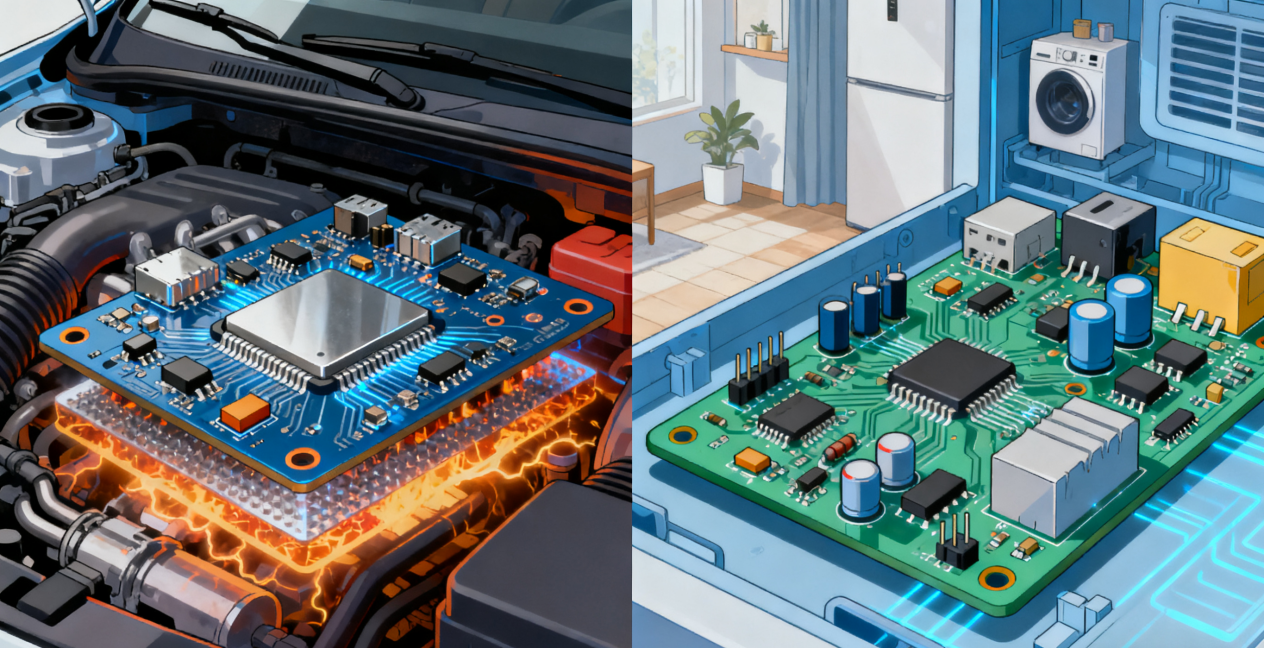
Think about household PCBs—like the one in your router. After 2 years, they often have loose parts or broken solder joints. But automotive PCBs? They’re exposed to daily vibrations and crazy temp swings (-30°C to 120°C) and still work steadily for over a decade. It’s not that they’re “naturally tough”—their work environments are just way different.
Household PCBs sit in a “comfort zone” (0–40°C) with no harsh shaking or oil. Automotive ones? They deal with engine vibrations, wild temperature jumps, oil splatters, even electromagnetic interference. That’s why they need a “tough design” from the start.
To tackle these challenges, automotive PCBs are built differently—from materials to structure—with two main types of fixes:
1. Vibration-Resistant Design: From “Easily Loose” to “Locked In”
l They use high-toughness, high-Tg base material (Tg ≥ 170°C). This stuff soaks up vibration energy and keeps the PCB from getting brittle after years of jolting.
l Solder joints use high-temp lead-free solder (like tin-silver-copper alloy). Its melting point is 30–50°C higher than household solder. For key parts, they even add “underfill adhesive”—like a tiny foundation—to hold components tight and stop solder joints from failing.
l Small structural tweaks: Vias have reinforcement rings (a copper circle around the hole) to avoid cracking. Traces use 45° angles or arcs (not sharp right angles) to keep stress from piling up and breaking the lines.
2. Extreme Temp-Resistant Design: From “Temp-Sensitive” to “Can Take the Heat (and Cold)”
l Materials get a full upgrade: Low-CTE base material (only half the thermal expansion of household FR-4) cuts down on deformation from temperature changes. The solder mask handles 150°C+ to keep it from getting brittle in cold temps. Key areas use thick copper foil (2oz or more) to resist rust and cracking when it’s freezing.
l They add active heat dissipation: Heat sinks stick to the PCB, or it’s hooked up to the car’s metal casing. This pulls heat away fast—important for parts near the engine, which get super hot.
l Strict testing before shipping: They have to pass 1,000 cycles of -40°C to 125°C and 1,000 hours of aging at 150°C. It’s like a “toughness test” to make sure they hold up long-term.
Here’s the bottom line: Automotive PCBs aren’t just “better” household ones—they’re built specifically for cars. Their cost and design fix problems household PCBs never even face. Next time you see an automotive PCB, you’ll know it’s a tough unit—tested to handle shaking and extreme temps—and why it costs a bit more.