loading
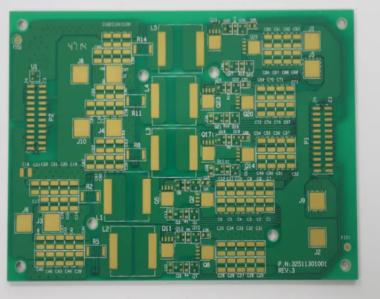
Introduction and Overview of 4-Layer Industrial Control Circuit Board Products
A 4-layer industrial control circuit board is a multi-layer printed circuit board (PCB) used for industrial control systems, whose main function is to provide reliable electrical connections and signal transmission for industrial equipment. Compared to double-layer or single-layer circuit boards, 4-layer industrial control circuit boards have higher signal integrity and stronger anti-interference capabilities, making them suitable for complex industrial control applications.
Main Features
Multi layer structure: A 4-layer industrial control circuit board consists of four conductive layers, usually including two signal layers, one power layer, and one ground layer. This multi-layer structure can effectively reduce signal interference and electromagnetic radiation, and improve the stability and reliability of signal transmission.
High density wiring: Due to the use of multi-layer design, 4-layer industrial control circuit boards can achieve higher density wiring, thereby supporting more functions and more complex circuit designs. This is particularly important for industrial control systems that require integration of multiple functions.
Excellent thermal management: 4-layer industrial control circuit boards usually use high-quality materials and advanced manufacturing processes, with good thermal management performance. This can effectively reduce the operating temperature of the circuit board and extend its service life.
Strong anti-interference ability: Through reasonable interlayer design and shielding measures, the 4-layer industrial control circuit board can effectively resist external electromagnetic interference, ensuring the stability and accuracy of signal transmission.
Application field
4-layer industrial control circuit boards are widely used in the following fields:
Automation control system: such as PLC (Programmable Logic Controller), DCS (Distributed Control System), etc.
Industrial robots: used to control and drive industrial robots, achieving precise motion control.
Power system: such as substation monitoring, distribution automation, etc.
Transportation: such as rail transit signal systems, intelligent transportation management systems, etc.
Energy management: control and monitoring of renewable energy systems such as wind power and solar power.
Technical Specifications
Number of layers: 4
Plate thickness: 1.6mm
Board: S1000H
Copper thickness: inner 1oz, outer 2OZ
Minimum line width and spacing: 0.1/0.1mm
Minimum aperture: 0.2
Surface treatment: Sinking gold 2U "
production process
The production process of a 4-layer industrial control circuit board includes the following main steps:
1. Design and Layout: Use EDA (Electronic Design Automation) software for circuit design and layout.
2. Material selection: Choose suitable substrate materials, such as FR4, ceramic substrates, etc.
3. Layering: The conductive and insulating layers are laminated to form a multi-layer structure.
4. Drilling: Use precision drilling equipment to process through holes and blind holes.
5. Electroplating and etching: Electroplating and etching are performed on the circuit board after drilling to form conductive paths.
6. Surface treatment: Perform surface treatment such as HASL (hot air leveling), ENIG (electroless nickel gold plating), etc.
7. Testing and Inspection: Conduct electrical testing and visual inspection on finished circuit boards to ensure quality.
Conclusion
The 4-layer industrial control circuit board, with its high-density wiring, excellent thermal management, and strong anti-interference ability, has become an indispensable and important component of industrial control systems. Its wide range of applications and superior performance make it play a key role in modern industrial automation.
If you have any questions or requirements about our 4-layer industrial control circuit board products, please feel free to contact us at any time.