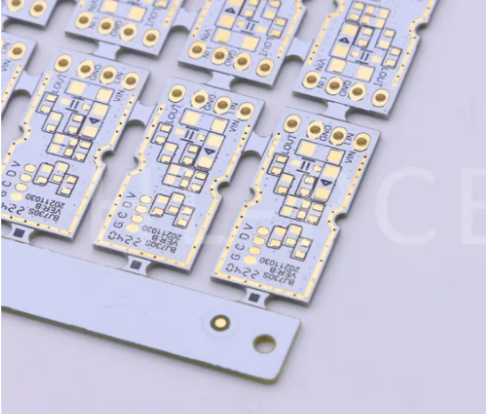
The double-sided car light PCB circuit board adopts a double-sided copper foil design, which can achieve complex circuit wiring in limited space. This PCB circuit board has excellent conductivity and heat dissipation performance, and can operate stably in harsh environments such as high temperature, high humidity, and high vibration, ensuring the reliability and lifespan of automotive lighting fixtures.
Product Overview
The double-sided car light PCB circuit board adopts a double-sided copper foil design, which can achieve complex circuit wiring in limited space. This PCB circuit board has excellent conductivity and heat dissipation performance, and can operate stably in harsh environments such as high temperature, high humidity, and high vibration, ensuring the reliability and lifespan of automotive lighting fixtures.
Product Features
2.1 High reliability
Using high-quality substrates and advanced manufacturing processes to ensure the reliability of PCBs in harsh environments such as high temperature, high humidity, and high vibration.
2.2 Excellent heat dissipation performance
By using double-sided copper foil design, the heat dissipation capacity of PCB is significantly improved, adapting to the high-power requirements of automotive lighting.
2.3 High conductivity
Double sided copper foil can provide better conductivity, reduce the resistance of the circuit board, and improve the overall performance of the system.
2.4 High anti-interference ability
By rational circuit design and shielding technology, the anti electromagnetic interference capability of PCB is improved to ensure the stability and accuracy of signal transmission.
2.5 High integration
Double sided design can achieve higher circuit integration, reduce system complexity and volume, and improve overall performance and reliability of the system.
Technical specifications and parameters
Number of layers: 2
Plate thickness: 1.6mm
Board: S1141
Copper thickness: 1OZ
Minimum line width and spacing: 0.2/0.2MM
Minimum aperture: 0.3
Surface treatment: lead-free tin spraying
Process key points: IPC III standard
Application field
4.1 Front headlights
Used for circuit control and driving of car headlights, providing high brightness and long-lasting lighting effects.
4.2 Tail lights
Used for circuit control and driving of car taillights, ensuring visibility and safety of the vehicle at night and in adverse weather conditions.
4.3 Fog lamps
Used for circuit control and driving of car fog lights, providing strong illumination that penetrates fog and improves driving safety.
4.4 Turn signal lights
Used for circuit control and driving of car turn signals, providing clear turn signals to ensure driving safety.
4.5 Other car lights
Used for circuit control and driving of other automotive lighting fixtures, such as daytime running lights, brake lights, etc.
manufacturing process
5.1 Circuit Design
Use EDA tools for circuit design and wiring to ensure the rationality and reliability of the circuit.
5.2 Material selection
Choose high-quality substrates and copper foils to ensure the performance and reliability of the PCB.
5.3 Etching
Etching is performed to form a circuit pattern.
5.4 Vias
Drill holes and perform electroplating to form vias.
5.5 Layering
Layer double-sided copper foil and substrate together to form a double-sided PCB.
5.6 Surface Treatment
Perform surface treatments such as HASL, ENIG, etc. to improve the soldering performance and corrosion resistance of PCBs.
5.7 Welding
Weld the components and complete the assembly.
5.8 Testing
Conduct electrical and functional testing to ensure product quality.
quality control
6.1 Raw material inspection
Ensure that the quality of the substrate and copper foil meets the standards.
6.2 Manufacturing Process Control
Strictly control every process to ensure product consistency and reliability.
6.3 Finished product testing
Conduct electrical performance testing, functional testing, and environmental testing to ensure that the product meets design requirements.
Product Summary
Double sided automotive light PCB circuit boards are widely used in various automotive lighting fixtures due to their high reliability, excellent heat dissipation performance, and high conductivity. Through reasonable design and strict manufacturing processes, efficient and reliable lighting solutions can be achieved to meet the diverse needs of automotive lighting systems.