loading
Product Overview
Product Features
Technical Specifications
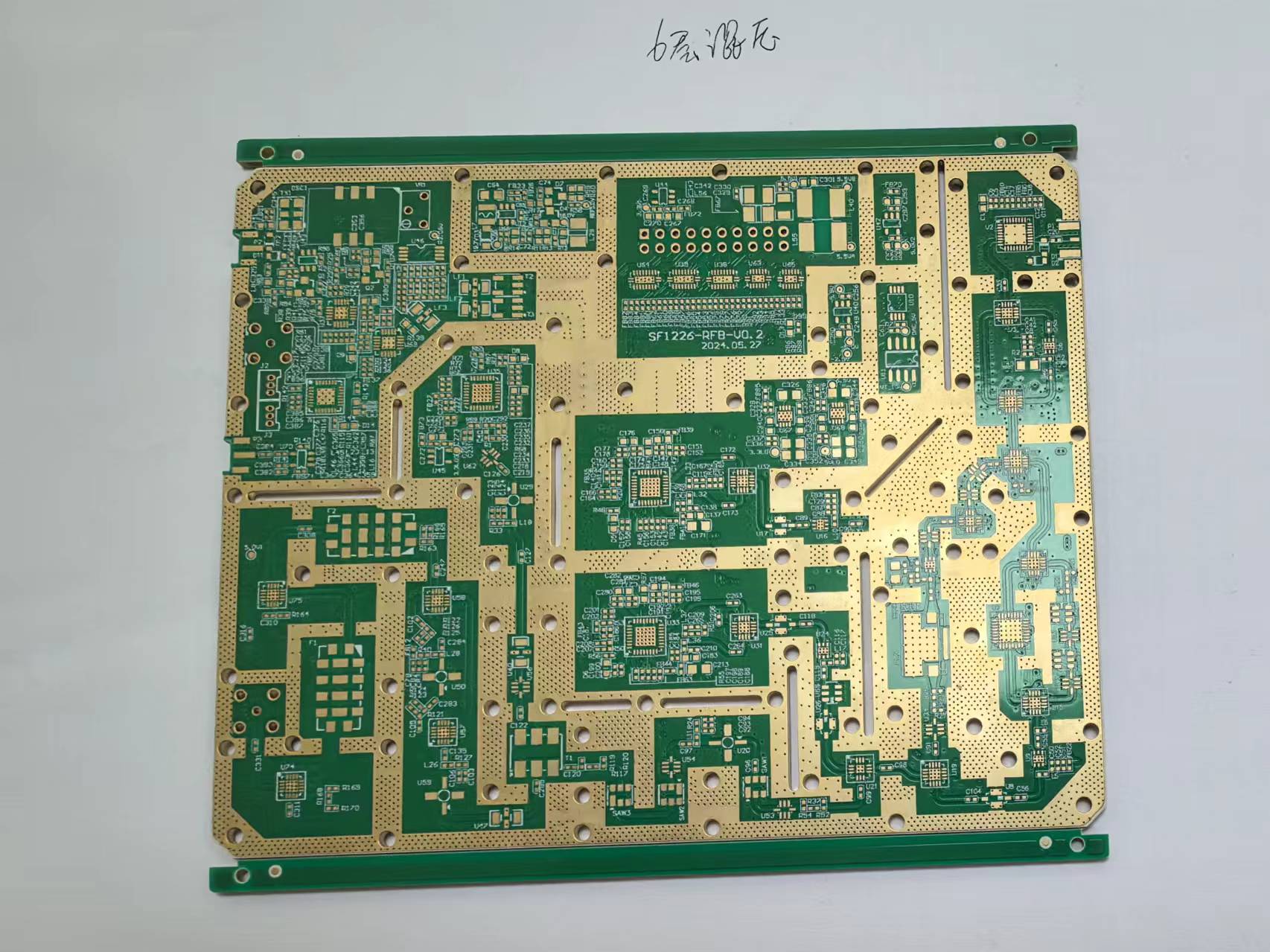
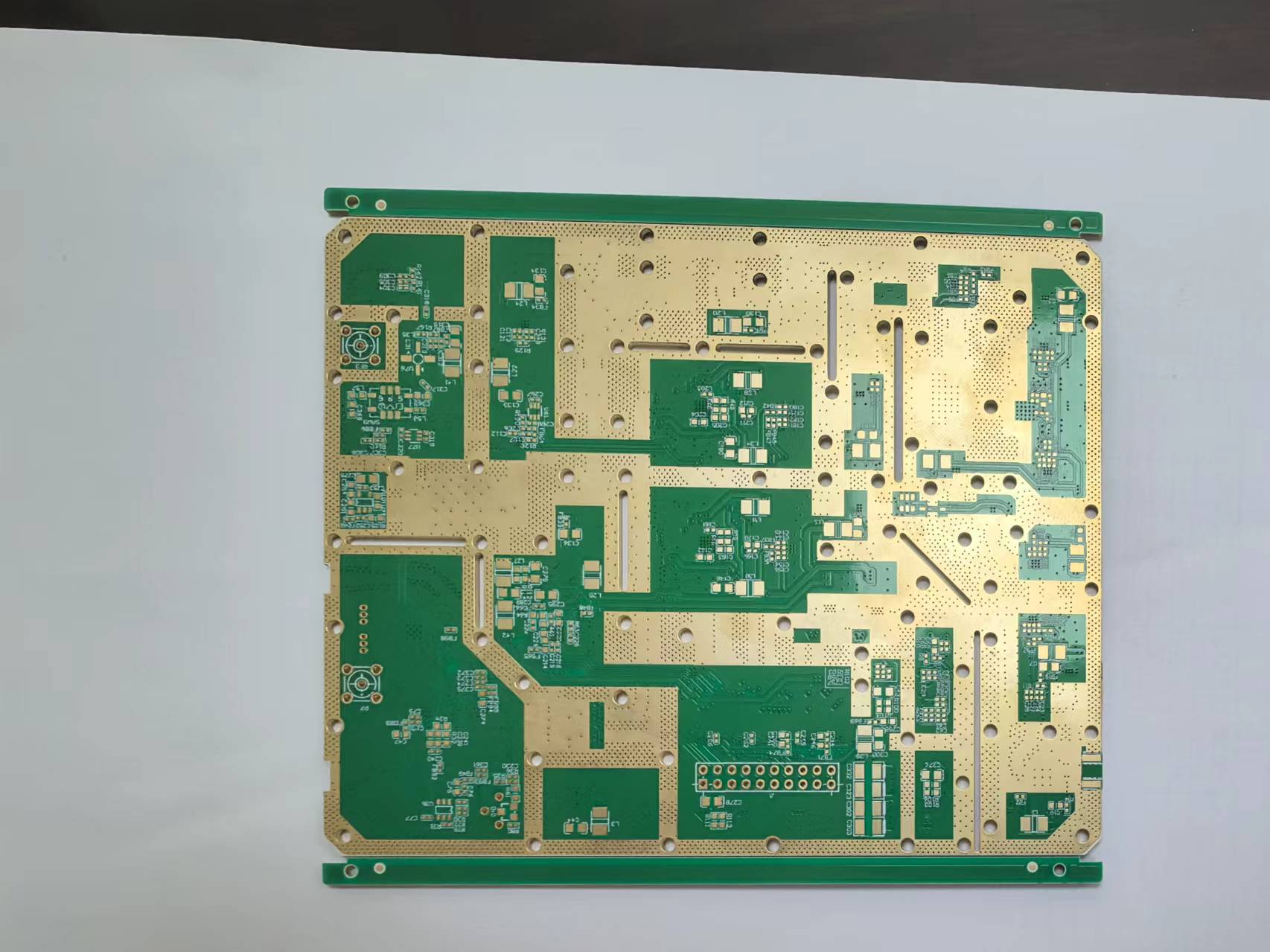
Layers: 6 layers
Materials: Rogers + FR‑4, S1000
Thickness: 2.0 mm
Copper Thickness: Inner 0.5 oz / Outer 1 oz
Solder Mask Color: Green solder mask with white text
Minimum Line Width / Line Spacing: 0.1 mm / 0.1 mm
Solder Mask: Yes
Surface Treatment: Immersion Gold (ENIG)
Application Fields
Communication Equipment: Base stations, antennas, RF modules, etc.
Aerospace: Electronic equipment for aircraft and satellites.
Radar Systems: Military and civilian radar systems.
Medical Equipment: Imaging equipment, monitoring equipment, etc.
Automotive Electronics: Automotive electronic systems for high-frequency signal transmission.
Production Process
Precision Etching: Ensures accuracy of circuit patterns and meets high-density interconnect (HDI) requirements.
Multi-layer Lamination: Bonds different material layers via high-temperature and high-pressure processes to guarantee electrical performance and mechanical strength.
Surface Treatment: Various surface treatments such as HASL, ENIG, etc., can be provided according to customer requirements to ensure soldering reliability.
Conclusion
FQA:
1. Q: How many employees do you have in your factory?
A: More than 500.
2. Q: Are the materials you use environmentally friendly?
A: The materials we use are in accordance with ROHS standard and IPC-4101 standard.
3. Q: How long does it generally take to deliver HDI high-frequency PCBs?
A: We have raw material inventory (such as RO4350B, RO4003C, etc.), and our fastest delivery time can be 3-5 days.
4. Q: What problems can impedance mismatch in HDI high-frequency PCBs cause?
A: The impedance of transmission lines on the PCB not matching the output impedance of the signal source or driver can lead to signal reflection, crosstalk, and signal integrity issues.
5. Q: Is there a coating layer between the copper foil and dielectric in RO3003 and RO3003G2 materials?
A: Rogers Corporation's RO3003 and RO3003G2 materials do not have a coating layer between the copper foil and dielectric. The dielectric layer and copper foil are directly laminated at high temperatures, which can be observed in cross-sections.
6. Q: Does chemical de-fluxing work on PTFE materials?
A: PTFE resin is highly inert, and chemical de-fluxing solutions have no effect on PTFE resin. However, for PTFE resin boards mixed with a large amount of ceramic fillers, chemical de-fluxing solutions can attack the ceramic fillers, thereby affecting the electrical properties of the board. Therefore, chemical de-fluxing is not recommended for PTFE boards with this structure.
7. Q: Can PTFE material be used as a bonding sheet and laminated with FR4 core board?
A: PTFE is a thermoplastic resin and can be used as a bonding sheet for laminating multilayer boards. However, its lamination temperature requires 350 degrees or higher, which most FR4 boards cannot withstand, so PTFE cannot be used as a bonding sheet to laminate with FR4 core boards.